

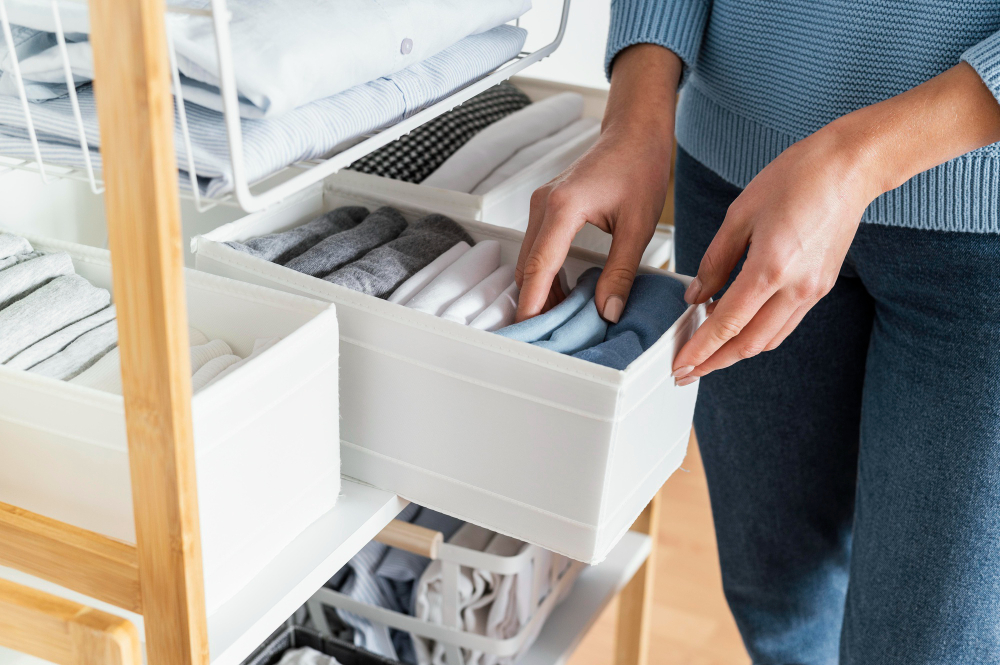
The most successful storage is rarely the storage you notice first.
It is the drawer that opens exactly where you need it. The entry cabinet that quietly absorbs shoes, coats, bags, and keys before they migrate through the house. The pantry shelf that allows every ingredient to remain visible. The laundry cabinet deep enough for supplies but not so deep that bottles disappear into shadow. These details may lack the drama of marble countertops or sculptural lighting, yet they shape the rhythm of a home every single day.
There is a particular kind of luxury in that ease.
Custom storage should not simply fill empty walls with cabinetry. Its purpose is more exacting: to understand what enters a space, where it is used, how frequently it is needed, and how effortlessly it can be returned when the task is finished.
That distinction matters most in the hardest-working parts of the home. Entries, kitchens, pantries, laundry rooms, closets, and multipurpose spaces collect the objects of everyday life. When their storage is poorly planned, clutter escapes into adjoining rooms. When it is planned intelligently, the entire home can feel calmer.
“True luxury in storage is not having a place for everything. It is having the right place for everything.”
Begin With Possessions, Not Cabinetry
There is a temptation in custom storage design to begin with elevations: a handsome wall of cabinetry, symmetrical doors, elegant open shelving, perhaps a perfectly centered bench. It looks finished before a single possession has been considered.
The process should happen in reverse.
Before deciding how many cabinets you need, document what those cabinets must contain. In an entry, count everyday shoes, seasonal coats, handbags, backpacks, umbrellas, sports equipment, pet supplies, and the small objects that arrive in pockets. In a pantry, measure the tallest bottles, widest appliances, bulk food containers, serving pieces, and groceries your household routinely keeps in reserve.
A closet deserves the same discipline. Separate short-hanging garments from long garments. Count shoes by type rather than treating every pair as identical. Measure luggage. Consider folded clothing, jewelry, accessories, laundry, and the objects that currently live somewhere else simply because the closet cannot accommodate them.
Custom storage becomes genuinely custom only when its dimensions respond to the objects rather than asking the objects to adapt to predetermined dimensions.
Frequency should shape the design as much as size. Everyday objects deserve the most convenient positions. Weekly items can move slightly higher or farther away. Seasonal possessions can occupy less accessible zones. Rarely used objects should not consume the most valuable storage simply because they happen to be large.
This creates a hierarchy that feels almost architectural. The most useful areas are positioned within comfortable reach; secondary storage surrounds them; long-term and seasonal storage moves toward the edges.
Visibility matters too. Deep cabinetry may offer generous theoretical capacity, but capacity is not useful when the objects at the back become invisible. A shallow shelf filled with frequently used pantry items may perform more elegantly than a cavernous cabinet twice its depth. Drawers and pull-outs can make deeper storage more accessible because the contents move toward you rather than requiring you to reach into darkness.
Before finalizing a custom design, ask one deceptively simple question: Can I see what I own?
If the answer is no, reconsider the configuration.
The Entry Should Absorb the Day Before It Reaches the Rest of the House
The entrance is one of the smallest spaces with the greatest influence over household organization. It receives everything: wet shoes, coats, backpacks, mail, packages, keys, sunglasses, umbrellas, sports equipment, dog leashes, and whatever else happens to accompany someone through the door.
Without intentional storage, these objects continue their journey. Shoes gather in hallways. Bags land on dining chairs. Mail reaches the kitchen counter. Jackets migrate toward furniture.
A well-designed entry interrupts that journey.
The first consideration is not how many hooks fit on the wall but who arrives through the door and what they are carrying. A family with school-age children requires a different system from a household of two adults. Someone who cycles to work has different needs from someone who regularly enters with a briefcase and overcoat.
Closed cabinetry can quiet visual clutter, but it should not become so formal that nobody uses it. A beautiful cabinet with doors concealing every hook may look immaculate; if opening those doors is one step too many for a child dropping a backpack, the backpack will probably land somewhere else.
The most effective entry storage often combines concealed and immediate-access elements. Everyday coats may belong on accessible hooks while less frequently used outerwear disappears behind doors. Shoes may live in ventilated drawers, shelves, or cubbies. A shallow drawer can capture keys and sunglasses. A dedicated location for bags prevents them from occupying furniture.
“Organization succeeds when putting something away is almost as easy as putting it down.”
Seating deserves practical consideration as well. A bench is not merely decorative when shoes are removed and put on there every day. But its dimensions and surrounding circulation need to allow someone to sit without blocking the entry route.
Then consider moisture. Wet coats and shoes should not be enclosed without thought for ventilation and appropriate materials. An entry in a rainy or snowy climate faces very different conditions from a formal foyer where outdoor footwear rarely enters.
Durability should therefore be integrated into the elegance. The finest entry isn’t precious. It can accept the disorder of arrival and quietly restore order once everyone has come home.
A Pantry Should Behave Like an Inventory System
A beautifully stocked pantry can be one of the most satisfying spaces in a home, but appearance alone is a poor measure of its success.
The pantry has one essential job: it should allow you to understand what food and supplies you own without conducting an archaeological expedition.
Deep shelves can be particularly deceptive. They appear generous until cans, boxes, and jars begin forming rows behind rows. Eventually, ingredients become invisible and duplicate purchases appear.
For frequently used foods, visibility is often more valuable than maximum depth. Adjustable shelving allows spacing to respond to actual product heights. Pull-outs can make deeper cabinets easier to navigate. Drawers can work well for certain packaged goods when the contents can be viewed from above.
And then there are appliances.
A pantry frequently becomes the default destination for mixers, blenders, slow cookers, food processors, serving dishes, and oversized cookware. Before specifying shelves, measure these objects—not only their width, but their depth and height. A beautifully proportioned shelf that is half an inch too short for the appliance intended to occupy it is not a small design error. It is wasted custom cabinetry.
Precision is what separates fitted storage from merely expensive storage.
Consider weight as well. Heavy appliances should not automatically occupy high shelves simply because they are used less often. Frequency and safe retrieval must be balanced.
If the pantry includes countertop appliances intended to operate there, electrical requirements, ventilation, heat, clearances, and manufacturer instructions should be resolved during design. Storage and appliance operation are not necessarily the same thing.
Finally, resist the urge to fill every available inch. A pantry designed at absolute maximum capacity on the first day has no ability to absorb a holiday grocery trip, a change in eating habits, or the arrival of a new appliance.
“Empty space is not always unfinished space. Sometimes it is the margin that allows a home to adapt.”
The Laundry Room Should Be Designed Around a Complete Cycle
Laundry rooms are often planned around appliances rather than laundry.
A washer and dryer are positioned against a wall, cabinetry is added above them, perhaps a countertop appears nearby, and the room is considered complete. Yet laundry is not one activity. It is a sequence.
Dirty clothes arrive. They may need sorting. Certain garments require stain treatment. Products need storage. Clean clothes need somewhere to land, fold, hang, and eventually leave the room.
Storage should support that entire cycle.
Frequently used detergent and supplies belong within comfortable reach of the machines. Backup products can move higher. A hanging rail can accommodate garments that should not enter the dryer. A usable counter can provide folding space, but only if it remains clear enough to perform that job.
That last point is crucial. Horizontal surfaces attract objects. If the laundry counter becomes the permanent home for cleaning supplies, baskets, paper products, and miscellaneous household items, its functional value disappears.
Cabinetry should therefore absorb the objects that would otherwise colonize the work surface.
Cleaning equipment may require tall storage. An ironing board, vacuum attachments, brooms, or mops need dimensions that ordinary base cabinets may not provide. Laundry baskets need somewhere to wait without blocking circulation. If the room doubles as utility storage, the design should distinguish laundry supplies from household maintenance items rather than allowing both categories to merge indiscriminately.
Ventilation, appliance clearances, utility access, and manufacturer installation requirements must remain accessible. Custom cabinetry should never make routine appliance servicing unnecessarily difficult.
The luxury of a laundry room is not elaborate cabinetry. It is the ability to move through the entire process without repeatedly relocating piles from one surface to another.
Closets Should Be Measured in Routines, Not Just Linear Feet
A closet is perhaps the clearest example of why more space does not automatically create better storage.
A large walk-in closet with a single hanging rod around its perimeter may waste substantial vertical volume. A smaller closet with carefully divided short hanging, long hanging, drawers, shelves, and shoe storage can feel considerably more generous.
The first measurement should be clothing length.
Shirts, jackets, folded trousers, and many skirts can often use shorter hanging zones, potentially allowing another rod below where appropriate. Dresses and long coats need uninterrupted vertical space. Treating both categories identically sacrifices capacity.
Shoes deserve their own inventory. Count everyday shoes, boots, athletic footwear, formal pairs, and seasonal items separately. Their dimensions differ, and the storage should acknowledge that.
Drawers can reduce visual noise by concealing smaller items, but they should be sized according to what they will hold. Jewelry requires different organization from sweaters. Accessories need different proportions from folded denim.
Lighting is equally important. A perfectly organized closet loses much of its usefulness if dark corners make colors and objects difficult to distinguish. Thoughtful illumination transforms storage from a cavity into a room that can actually be read.
Mirrors, seating, charging, laundry storage, and dressing surfaces should only be added when they support a real routine. Custom closets can easily become crowded with desirable features that ultimately reduce circulation and usable storage.
“The most elegant closet is not the one that displays the greatest number of possessions. It is the one that makes choosing, dressing, and putting things away feel effortless.”
And perhaps most importantly, design for change. Wardrobes evolve. Households change. Storage requirements that feel exact today may become restrictive tomorrow.
Adjustable shelving and adaptable sections introduce a degree of resilience that fixed compartments cannot always provide.
Build Storage Around the Life You Have, With Room for the Life Ahead
The temptation with custom storage is perfection. Every object receives an exact compartment. Every shelf is filled. Every drawer has a designated purpose. The finished system looks almost architectural in its precision.
But homes are not static compositions.
A child starts a new sport. Someone begins working from home. A new appliance enters the kitchen. Winter coats multiply. Hobbies change. Guests arrive. The objects a household needs are constantly shifting.
The best custom storage therefore balances precision with flexibility.
Design the fixed elements around the things unlikely to change: appliance locations, architectural openings, major hanging requirements, essential household routines, and large objects. Allow adjustable shelving, flexible dividers, and some intentionally unassigned capacity to accommodate everything else.
Before approving the final design, conduct one last exercise. Mentally walk through an ordinary day.
You enter carrying groceries. Where do the bags land? You remove your coat and shoes. Where do they go? You prepare breakfast. How many cabinets do you open? You wash clothes. Where does the clean laundry wait? You dress for work. Can you reach everything you use without moving something else first?
If the storage plan supports those ordinary moments, it is doing something more important than creating beautiful cabinetry.
It is removing friction from the home.
“The highest expression of custom storage is not abundance. It is effortlessness.”
That effortlessness comes from details that may never be admired by a guest: a shelf placed at precisely the right height, a drawer close to the activity it supports, enough breathing room around a bulky appliance, a hook positioned exactly where a bag naturally lands.
These decisions are quiet. Their value accumulates through repetition.
Every morning becomes slightly easier. Every return home feels slightly calmer. Every cupboard opens with less searching. Every room carries less clutter because possessions have somewhere sensible to disappear.
That is when organization begins to feel luxurious—not because the home contains more cabinetry, but because the cabinetry understands the home.
